
Have you ever wondered how many bones a dog has or how their bodies are structured? Understanding a dog’s skeletal system is essential for pet owners, veterinary students, or anyone curious about canine health. Dogs are remarkably agile, strong, and flexible, and much of this depends on their bones, joints, and overall anatomy.
If you’ve been searching for answers to questions like “dog anatomy diagram,” “internal anatomy of a dog,” or “dog body parts name,” this guide will provide everything you need to know. From the total number of bones to a breakdown of major skeletal regions, you’ll gain a clear understanding of how your dog’s body functions and moves.
🦴 Total Number of Bones in a Dog
Dogs typically have around 319 bones, but the exact number can vary depending on the breed and tail length. Smaller breeds might have slightly fewer bones, while larger or long-tailed breeds may have more.
The dog skeleton is divided into several key regions:
- Skull – Protects the brain and supports facial structure.
- Spine/Vertebral Column – Includes cervical, thoracic, lumbar, sacral, and caudal vertebrae.
- Ribs and Sternum – Protects vital organs like the heart and lungs.
- Limbs – Front legs (forelimbs) and hind legs (hind limbs) provide mobility and strength.
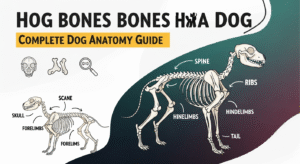
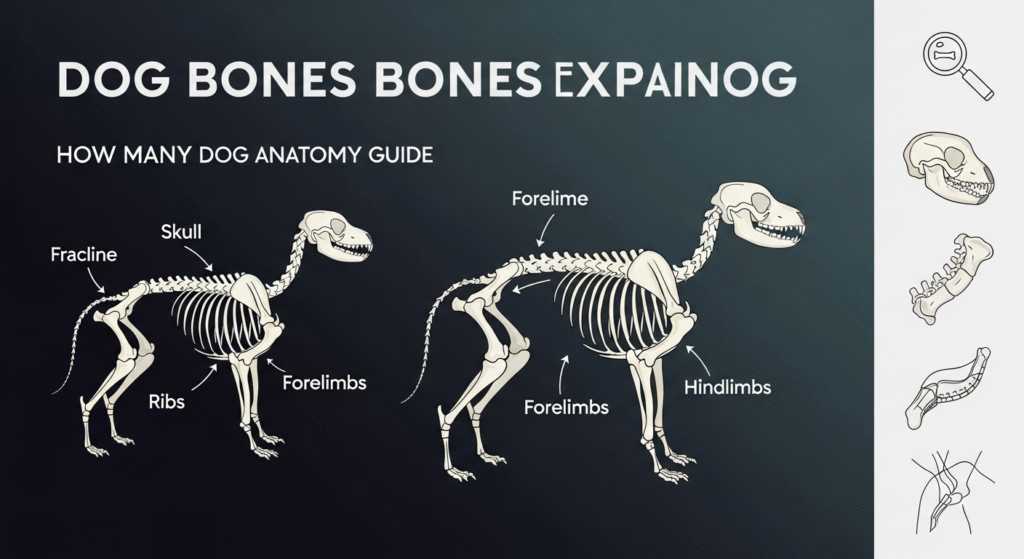
🐶 Dog Skeleton Diagram
While a diagram can make it easier to visualize, here’s a simplified description:
- Skull: 50 bones including jaw and facial bones
- Spine: 50–51 bones depending on tail length
- Ribs: 26 bones
- Forelimbs: 80 bones (shoulder, humerus, radius, ulna, paw)
- Hindlimbs: 80 bones (pelvis, femur, tibia, fibula, paw)
- Tail (Caudal Vertebrae): 20–23 bones
This structure allows dogs to be fast runners, agile jumpers, and strong diggers, depending on their breed.
🐾 Dog Anatomy and Physiology
Understanding bones isn’t just about counting them—it helps you understand how dogs move, heal, and grow.
Growth and Development
Puppies are born with more cartilage than bones, which gradually ossifies (hardens) as they age. This is why young dogs’ bones are more flexible, and why careful handling is crucial to avoid injuries during growth.
Joints and Movement
Dogs’ joints, including the elbows, knees, hips, and shoulders, are designed for efficient locomotion. Large breeds may be prone to joint issues like hip dysplasia, so understanding skeletal anatomy is vital for prevention and care.
Common Skeletal Issues
- Fractures: Often occur due to accidents or falls
- Arthritis: Degeneration of joints in older dogs
- Hip Dysplasia: Malformation of the hip joint, common in large breeds
- Spinal Problems: Herniated discs or vertebral issues affecting mobility
Regular check-ups with a vet, proper nutrition, and safe exercise routines help maintain strong bones and healthy joints.
Check Here: Common Dog Questions Every Pet Parent Asks
🦴 Human Bones vs Dog Bones
While dogs and humans share a similar skeletal structure, there are key differences:
- Dogs have a longer spine and tail with more vertebrae.
- Dogs walk on four legs (quadruped), so their limb bones are oriented differently than human legs.
- Dogs’ skulls vary significantly between breeds, affecting the number and shape of facial bones.
📝 Why Knowing Dog Bones Matters
Whether you’re a pet owner, trainer, or student:
- Helps understand movement and posture
- Aids in preventing injuries
- Guides rehabilitation after fractures or surgeries
- Enhances knowledge about breed-specific skeletal traits
🔍 Final Thoughts
Dogs have a fascinating skeletal system with approximately 319 bones, providing strength, flexibility, and agility. From the skull to the tail, each bone plays a critical role in supporting their body, protecting vital organs, and enabling movement.
By learning about dog anatomy and physiology, you can better care for your pet, prevent injuries, and ensure a healthy, active life. For visual learners, consulting a detailed dog anatomy diagram can make understanding easier and more practical.